
Transparent Medical Transcription Pricing
Maximizing ROI in Healthcare
In today’s healthcare environment, margins are tighter than ever. When you search for cheap medical transcription, you aren’t looking for “low quality”—you are looking for efficiency. This guide explores how cost-effective documentation drives a higher Return on Investment (ROI).
How Medical Transcription Pricing Works
To maximize ROI, you need to understand the mechanics. Professional transcription is typically priced based on measurable output.
Volume
Higher volumes often allow for better economies of scale.
Turnaround Time (TAT)
Faster requirements (STAT or 4-hour) typically incur a premium compared to standard 24-hour turnaround.
Specialty Complexity
General notes are often faster to transcribe than complex operative reports.
Dictation Quality
Clear audio reduces processing time, while heavy background noise can add complexity.
Understanding Medical Transcription Cost per Line
The industry standard for pricing is medical transcription cost per line. But what exactly constitutes a “line”?
Transparency is key: A standard line is typically defined as 65 characters (including spaces). This model protects the client; you pay only for the text produced, not for the time a transcriptionist spends listening to audio or pausing the recording.
Why Superior to Per-Minute? Pricing per minute can be misleading. If a physician dictates slowly or pauses frequently, you pay for silence. With a per-line model, you pay strictly for the documented data.
Cheap Medical Transcription Without Compromising Expertise
The most common objection we hear is: “If it’s cheap, is it accurate?”
At Cheap Medical Transcription, our affordability is a result of operational efficiency, not a lack of skill. We have stripped away the bloated overhead, expensive marketing teams, and administrative layers.
- Experienced Transcriptionists: Skilled professionals fluent in medical terminology reduce editing time.
- Streamlined Workflows: Digital platforms minimize friction and administrative bottlenecks.
- Accuracy Over Rework: Aiming for 99% accuracy prevents the costly back-and-forth of corrections.

Outsourced Transcription ROI: The Business Case
Do not just look at the invoice. Look at the return on investment.
Reclaiming Physician Time
The most expensive resource is the provider’s time. Outsourcing allows providers to dictate quickly and move to the next patient instead of typing data.
Reducing Admin Overhead
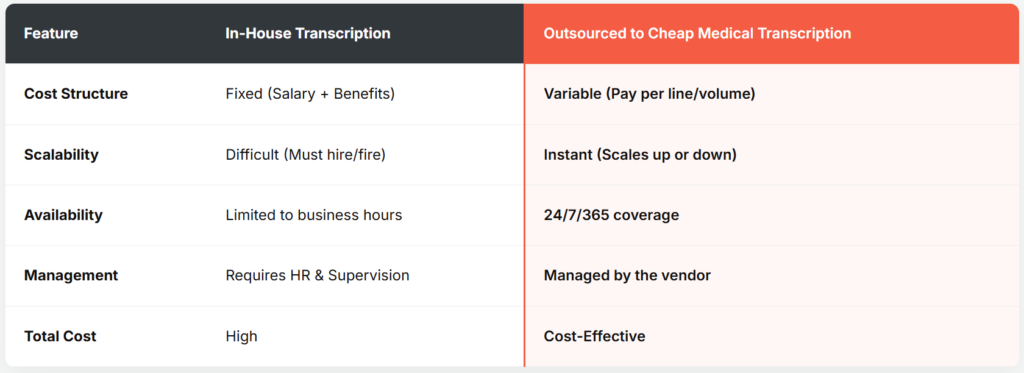
Convert fixed costs (salaries, benefits, taxes) into a flexible, variable cost that scales directly with your patient volume.
Improving Billing Speed
Accurate transcription leads to accurate coding. Reduce "Days in AR" and minimize claim denials caused by vague records.
Why Outsourcing Beats In-House Transcription
For many practices, this shift is the single most effective cost-saving measure.
Who Benefits Most from Cost-Efficient Transcription?
Solo Practitioners
Need to keep overhead low to maintain profitability.
Small to Mid-Sized Clinics
Need professional-grade documentation without a hospital budget.
Medical Billing Companies
Rely on accurate source documentation to maximize revenue.
Multi-Specialty Practices
Need a single vendor for diverse terminologies.
Addressing Common Objections
We believe in total transparency.
No. While technology assists the process, medical documentation requires human judgment. We utilize human transcriptionists and editors to ensure context, grammar, and complex medical syntax are correct.
Not at all. You maintain full access to your records. Furthermore, HIPAA-compliant transcription pricing does not mean we cut corners on security. We utilize encrypted file transfers and strict confidentiality protocols.
Absolutely. Inaccurate records are a liability risk. Our business model relies on long-term client retention, which is only possible if we consistently deliver high-quality, clinically accurate charts.
Ready to lower your documentation costs?
Choosing Cheap Medical Transcription is a smart financial decision. Stop paying for overhead and start paying for results.